Posted on April 28, 2007 By OneMysticalMonkey
“They have a soft heart”. We’ve all heard the phrase at one point or another, and we all know that it’s usually meant in a more-or-less derogatory context instead of in a complimentary one. When we hear (or use) this phrase, it implies that the person being spoken about is a pushover or somehow weak, and that having a “hard heart” is the preferred attitude for dealing with whatever situation is being referenced.
But let’s think about this for a second; it is implied that the best, most efficient, and strongest way to deal with most situations (and, by extension, people) in our lives is with a “hard heart”. Is this really what we believe on a societal level? Well, for the most part, the answer is yes. Unfortunately, most people consider the idea of having a soft heart as a point of weakness. “Soft” is associated with the feminine, with emotion, sympathy, compassion, gentleness, and although we don’t often admit it, love. Having a hard heart, however, is normally associated with the masculine – with action, strength, determination, emotional detachment, perhaps with bravery, and a certain efficiency and effectiveness.
But at what point did being rough and unemotional become synonymous with action and strength? And at what point did this become the preferred way of dealing with life and with each other? Why is having a “soft”, sympathetic, compassionate perspective considered weak? Should we really have a “hard heart” when we deal with the situations and people in our lives? Or perhaps things would go more smoothly if we could step out of our ego, out of the inertia and irresponsibility fostered by our hard heart, to deal with each other out of compassion and understanding instead.
It takes a stronger individual to look at and interact with life from a soft, compassionate perspective than from the hardened, arrogant point of view. It easy to hide behind “hard”. There’s no responsibility there, no compassion, no honesty. But it takes a brave soul to deal with life openly, compassionately, “softly”. Which do you choose?
Evolution to Light • Nudges & Ponderings
Posted on April 26, 2007 By OneMysticalMonkey
A double-whammy of an idea today: Discipline and Intent… or is it?
According to the dictionary, the definition of “Discipline” emphasizes training, control, or a penalization for inadequate control or for not adhering to a set of rules. And usually we humans think of all these things in an external way: reprimanding our kids or pets or subordinates, and perhaps the kind of determination and drawn out training associated with the acquisition of specific skills (dance, martial arts, sometimes even with educational pursuits, etc.). While “Intent”, according to the dictionary, is basically the act of intending or designing actions or events toward a specific goal. And again, we tend to apply this definition toward an outward, external result or physical goal.
Both these terms certainly have applications in the physical, but in the metaphysical/spiritual realms, they seem to take on a whole new tenor of meanings. There is the discipline of internal study, the discipline of getting to the zafu daily, the intense self-discipline of actually meditating (instead of zoning out) once you are sitting, the post-meditation discipline of mindfulness, and more. So where does “Intent” come in to all that? Everywhere!
What is your intent as you approach the meditation cushion? Is it actual mindfulness meditation (which approach?), chakra meditation, the meditation of reflection, is it gaining insight and guidance from the spirit realm, healing, relaxation, something else? Do you even know what your intent is each time you exert the physical discipline and go to the zafu to sit?
Intent goes hand-in-hand with the manifestation of reality, and maintaining awareness of intent -on all levels, and at all times- is where the discipline comes in. True mindfulness, from personal experience, is the discipline of being aware of your intent (obvious and subtle thoughts) as well as being aware of your actions – all the time.
I can’t always manage that definition, but from experience, identifying and solidifying my intent goes a long way towards the success of my goal – whether it’s applied toward a meditation session, getting the offer from a job interview, or anything else. It’s also why I sometimes find myself approaching the zafu several times a day, each time with a different intent in mind. Identifying my intent, and then applying discipline (or applying intent to the discipline?), helps focus my efforts on the cushion… and often provides more immediate and satisfying results.
Namaste!
Metaphysics • Nudges & Ponderings
Posted on April 23, 2007 By OneMysticalMonkey
Ok, yes yes I’ve been a little out of the blogging loop the last few days! I’ve started several entries and just can’t seem to manage the undisturbed, conscious brain-power to put anything more than a small unfinished paragraph together! *siiigh* So what’s a blogger to do? Well, this blogger has decided to post something that at least indicates that the blog is not forgotten, that the Path is not forgotten, but that “life” is just getting the better of me lately… including strained concentration and an ability to meditate that is handicapped by a lack of sleep. So yes, I need to get some sleep. But that is easier said than done sometimes (this being one of “those” times for me).
So why do we need sleep anyway? Well, there are a number of philosophies about this. There’s what most folks think of as traditional psychological approach; Sleep provides your subconscious a way to work out the problems and stresses of your daily life. Then there’s the physical aspect that sleep provides a level of muscular and mental relaxation difficult to achieve in our waking lives, and provides an opportunity for our hormones to balance themselves. There is also the metaphysical perspective: Sleep allows your spiritual self to replenish by reconnecting with the higher planes of existence while in the dream state, and that your dreams bring you messages for spiritual evolution.
And most people don’t get enough sleep. What happens then? It would seem that the assorted aspects of ourselves are adversely affected by not enough sleep. Physically, clarity of thought is harder, physical reactions are slower, patience is limited, emotions tend to be a bit more extreme and frequent, as well as a host of other symptoms which amount to a lower quality of waking, conscious hours. There’s also the spiritual implication that with limited sleep, we are not getting the messages from Spirit to evolve as quickly as we may otherwise. So if our sleep is limited, are we therefor limiting our own evolution and ascension? It seems that we may be doing just that. Perhaps the amount of violence in the world can be attributed to global sleep deprivation? Interesting thought.
And on that note, it’s nap time! Sweet dreams!! Zzzzzz……
Healing & Wholeness • Nudges & Ponderings
Posted on April 20, 2007 By OneMysticalMonkey
If you’re on the spiritual Path, you are probably inundated with all kinds of colors, symbols, rituals, and their various and assorted meanings, trying to sort through it all and discover for yourself which ones work for you (I know I am!). There are so many options! And there are so many experts available, willing to tell you exactly what each thing means and why. But why are there so many discrepancies in the meaning of the same thing – especially when some of those meanings are quite contradictory to each other? Is it a cultural thing? An evolutionary thing? Or is it that ultimately meanings are determined through the shade of our own individual perceptions?
Sometimes, accepting the given, common meaning of a thing is the easiest thing to do; it’s the one that most people believe, and with that belief, held by so many people, a certain power or meaning of the thing is created. But does it make sense to you? Do you even question whether the common meaning applies to your experience of the symbol, color, etc.? Should you?
I believe that ultimately, symbols and colors have whatever meaning you bring to them – that it’s a personal thing, based on our personal experiences and dealings with the color, symbol or what-have-you. There may well be some things of this ilk which have a certain inherent power, aura, meaning… some of the sacred geometry or other things which have developed in various cultures and countries independently, perhaps… but does it mean anything to you personally? Not unless you are in-tune with the higher levels on which these things naturally operate and perhaps not even then. Hmmmm.
So what’s a poor metaphysician to do? By all means, read and learn, but question everything, and realize that your best judge of things is yourself. What meaning may apply to one person may not apply to you, and your experience of -and with- the color, shape, symbol, etc., may be vastly different from that other person’s experience. Ultimately, it’s your experiences that determine the meanings behind things for you, and they mean whatever it is you bring to them.
Metaphysics • Spirituality
Posted on April 19, 2007 By OneMysticalMonkey
Information. Technology. Connectivity. Faster. More. Zooming through cyberspace, and indeed, the World. Yes, there are definite advantages to the web for information, for connecting to others, for sharing ideas and information, as there are advantages to having cars and being able to get groceries “just around the corner”, on a whim. But is bigger and faster and more always better, or does it serve as background noise -an ongoing distraction from the World immediately around us? What happens if we trade in that high-bandwidth “go go go” mentality for a while? Can we even get ourselves to do it? For a day? A week? At all? Are we afraid of the ensuing silence -of our own thoughts? What will we discover in the quiet space?
Of course, there’s another layer beyond physically unplugging ourselves from our microcosm for a while. That layer is whether we have, or can develop, the ability to stop that incessant chattering of our own minds and egos (emotions). Unless we can rein in this more challenging aspect of ourselves a bit, unplugging physically only gets us so far. (This is where mindfulness and meditation practice comes in 😉 ).
If you can unplug, suddenly “life” seems a bit surreal when you come back to where you left it. Perhaps, in those “stolen” moments of quiet we’ve discovered a different connection… one to the Earth, one to Nature, to each other, and perhaps to even a bit of our own Divinity. Is this process, this ability and need to disconnect, a matter of awareness? Is it a necessity?
Does the bird chirping in the tree even exist if we are making too much internal and/or external noise to hear it?
*goes off to listen to the wind blowing through the trees*
Namaste!
Metaphysics • Nudges & Ponderings
Posted on April 15, 2007 By OneMysticalMonkey
Pitter patter,
Pitter patter,
Drop drop drop,
Each drop
To the others
is added,
Creating a pool,
a whole universe.
Life,
Precious life
Starts.
Life,
Precious life,
Develops.
More and more
The occupants,
Assured of speciality,
Of uniqueness,
Of self,
Grow dependent
On each other,
Grow dependent
On the pool.
What happens when the sun shines?
*original poem, One Mystical Monkey, 15 April 2007. All rights reserved.
Creative Corner • Metaphysics
Posted on April 13, 2007 By OneMysticalMonkey
We as a species tend to identify ourselves by our age, our race, our gender, our ethnicity, our religion, our family, our country, our physical attributes, the clothes we wear, the things we do, and by many other factors as well. But why is it so important for us to label ourselves like this? Why is it so important to us to be a part of a larger group? Well, it gives us a sense of association, of belonging to a group, to a history, to the beliefs, to the various aspects of the physical world. But as comforting it may be to feel that sense of belonging to some group or groups, this kind of self-identification also serves to separate us from each other: the Jews from the Christians, the English from the French, the tall from the short, the affluent from the poor… Well, you get the idea.
This tendency for labels satisfies our ego -that little nagging voice in the back of our heads that tries to convince us that we are individuals, and that we are (self) important- the voice that tries to convince us that we are different and valuable in a way others around us may not be, merely because we belong to a group “they” don’t. And although it can be beneficial to gather in some of these self-proclaimed groups for various reasons (spiritual pursuits, family holidays, the local swim team), these divisions among people also often lend themselves to abuse and destruction. How many wars have been waged over the perceived differences in beliefs, and how many playground fights have been fought over perceived affluence or skin tone?!
These kinds of labels encourage the duality that is our human existence – the thought that we physical beings are somehow and something “other” than spiritual beings. And because so many of us have lost touch with our true spiritual sides, we reach for an alternative – a bandaid to bridge the gap of isolation and give us the sense of belonging for which we yearn as human beings. But these identifications, labels, and divisions are artificial and superficial. Instead of reaching for the bandaid, we need to remember that we are all part of the same whole – merely different examples of the same One Spirit. We are human, and that is our commonality. We are spiritual beings, and despite the regular nagging from our ego, we are ultimately working together for the benefit of all creatures – whether we realize it or not. We are bound together in this existence, and all other attempts to label and define and identify are utterly meaningless…
Let’s make an effort to consciously break through these labels and resulting divisions. Let’s leave our egos in the proverbial dust and shatter the illusions that separate us from each other, and from Spirit. Let us realize our commonality as Spiritual Humans, and work together. Everything else is merely illusion.
Namaste.
Metaphysics • Nudges & Ponderings
Posted on April 12, 2007 By OneMysticalMonkey
The Flower of Life: an ancient, pervasive cultural symbol and a prime example of sacred geometry. It is said to represent a number of philosophical and spiritual ideas and concepts, including the building blocks for the universe (Platonic Solids). The Flower of Life is often used as a metaphor for the interconnectedness of all life (and spirit) in the universe, and has been found throughout the world in all major regions and within all major religions over the centuries.
Today, I invite you to share my version of the Flower of Life, in yantra (or mandala) form. Enjoy.
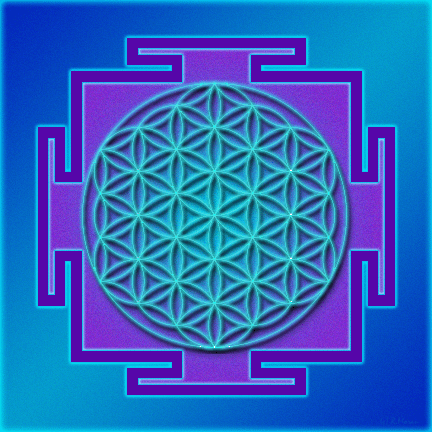
* Please respect my artistic copyright on this image, and do not download, alter, republish, or claim for your own the image here without prior written approval. This image was created by me, and all applicable copyrights apply. Thank you.
Creative Corner • Metaphysics
Posted on April 11, 2007 By OneMysticalMonkey
Would you, given the opportunity, willingly swallow a pill (or step into a box, or jump down the rabbit hole, or enter the Matrix, etc.) that would essentially make sure that your life was happy and absolutely perfect -give you everything you want- from that moment on? It’s not a new concept, but it’s an interesting philosophical question.
Think about that for a minute.
Would you do it? …Why?
…
…
Tempting though it may be for some, and assuming it is the physical world about which we are speaking and not the metaphysical/spiritual, I wouldn’t do it. It is our experiences, and our free will to choose those experiences for ourselves, which help shape who we are – in this world, as well as in the spiritual world. Who we are not a static thing – we change minute to minute, experience to experience. Goals change with each new experience. It is our failures, and our negative experiences which help shape us just as much as our successes and positive achievements. They are two sides of the same coin, and to remove one side of that coin would alter us in ways that we can’t even imagine… no matter how tempting the promises of doing so may seem at the time.
Can we really anticipate our wants and needs 20 years from now? A year from now? Even a week from now? Can we anticipate what is in our best long-term interests in one moment, based on our current selves, to appropriately set such a device for our indefinite future? And if the device in question were “smart” and able to adapt, then we introduce the concept of an external force monitoring us and making decisions for us on a regular basis. Although that happens quite a bit in the world already (governments, families, peers, society as a whole, making decisions for the individuals who comprise the country/family/etc.), how is some external force supposed to really decide what is in another person’s best interest (on that kind of personal, intimate level) for the long-term? Especially when what’s in our best interest long-term is not “perfect” by our immediate, short-termed, definition of things?
So would you go down the rabbit hole? Or do all paths lead there anyway?
Metaphysics
Posted on April 10, 2007 By OneMysticalMonkey
Emotional self-responsibility – what a proverbial mouthful! But what does it mean? Well, it means exactly what it says: accepting the responsibility for your emotional self. Hmmmm. Okay… and what does this mean? Basically, it means being conscious of our emotional reactions and the effect they have on a situation. It means being aware that our perception of “reality” is not the only perception of things – that everyone perceives things differently, and that our perception of things is affected largely by the (pre-existing) emotional state we bring to a situation.
Our perceptions of reality are also colored by our emotional reaction to a situation. How often do we have an emotional reaction to something that is said or done? How often do we attempt to blame others for our emotions or our reactions to things? It is entirely possible that another person may have done something you didn’t appreciate, or something that affected you adversely, but did they somehow force you react to the situation badly? Did they make you feel anger or frustration or joy? No, they didn’t; but you did. Each of us chooses our emotional state and our reactions to things all the time – but how often are we willing to admit it and accept responsibility for them? This is what emotional self-responsibility is about.
Be aware of your emotional state. Be aware of your reactions to things, and take responsibility for the emotional choices you make. It may take some practice, but eventually you may find that instead of your emotions controlling you, you are the one controlling them instead!
Namaste!
Nudges & Ponderings